

It was 20 years ago that I rode my bike across the state of Iowa in the summer of July of 2006. I rode in the RAGBRAI cycling event with 12,000 other riders. I was recently thinking about and reflecting on that event as I began this third week of July. What has stayed with me about that experience is not the visual scenery of Iowa. It’s what I felt as I pedaled 471 miles zig zagging through miles of corn fields on the back roads experiencing the hospitality in the small rural farm towns of Iowa. Below is a reflection and key memories of that ride.
Riding Across Iowa
RAGBRAI is an annual week-long bike ride across Iowa. It’s sponsored by the Des Moines Register newspaper. It was started back in the 1970’s by two newspaper reporters who rode their bikes across the state to showcase the small rural towns of Iowa. It quickly became a annual event drawing hundreds and today tens of thousands. Back in 2006, it drew 12,000 riders (today over 20,000 people do the ride each year). In 2006, I was a serious long distance cyclist and RAGBRAI was a bucket list item. I was 52 when I did the ride and at the peak of my cycling fitness.
I trained for the ride and was in great shape to handle the distances. But, I wasn’t prepared for the brutal physics of the mid-summer Iowa heat and humidity. The heat didn’t just sit on the asphalt; it radiated right through the soles of my cycling shoes. It was the third week of July 2006, and the Iowa humidity turned the air into something thick enough to chew. For seven days, I was coated with sweat constantly from sunrise to sunset.
I also wasn’t prepared for all the hills – I thought Iowa would be flat. The 2006 ride would go down as one of the hilliest routes in RAGBRAI history. Cresting over 22,000 feet of climbing across the week, the ride quickly shifted from a recreational challenge into something deeply elemental. I would be pedaling on an asphalt ribbon going up and down hills roads bordered by endless fields of corn and soy beans. The route would take us from the banks of the Missouri River in Sergeant Bluff all the way to Muscatine on the Mississippi River. It was, without a doubt, the most difficult thing I have ever done.
The Anatomy of a RAGBRAI Day
Every day began exactly the same way: my alarm would go off in the dark, and I would be packed up and on my bike, pedaling by 6:00 AM. We started that early for one simple reason—to beat the crushing afternoon sun and heat before it completely exhausted our bodies.
Leaving Sergeant Bluff that very first morning, the true spirit of Iowa hospitality revealed itself in the gray dawn light. There, standing at the edge of their driveways in their bathrobes and slippers, were several local ladies. With sleepy smiles, they were holding out boxes of fresh donuts and steaming cups of coffee, sending us off with goodbyes, well wishes, and smiles before the sun took over. It was the first of many acts of kindness that I would experience along the route.
Here was my daily schedule –
[6:00 AM] ➔ [7:00 AM] ➔ [10:00 AM] ➔ [12:30 PM] ➔ [2:00 PM] ➔ [4:00 PM]
Roll Out Farm Burrito Morning Pie Town Lunch Midday Pie Camp, Shower, & Church Dinner

Breakfast break at a local farm along the road
I always took it slow during the first hour of riding. I wanted to loosened up from sleeping on the ground, get my muscles warmed up, and get my head into that days ride. Around 7 am I was ready to fill my tank with a a hearty breakfast. I’d look for a local farm with tent canopies set up in the front yard. I’d pull off the blacktop where the family had set up a makeshift camp kitchen right on the grass. The smell of sizzling bacon and fresh coffee filled the air. I’d grab a massive, hearty breakfast burrito with some fried potatoes for my breakfast to fuel the next leg.
By 10:00 AM, my calorie tank would be dipping again. I’d look for the another farmhouse with a handmade sign at the end of the gravel driveway, pull over, and sit in the shade of a tree to slowly eat a slice of delicious homemade pie.

Pie break at a local church
Lunch was usually a hearty meal in one of the official midday stopover towns, but the eating didn’t stop there. Right after lunch, around 2:00 PM, I’d stop for a second “midday pie break” or some fresh cooked sweet corn to get me through the final, hottest miles of the route. By the time I finally approached the overnight town, I had a strict mission: find the Pork Belly Ventures camp, shower up, and immediately head into town to search out a local church for a delicious dinner. I was burning 4,000 – 6,000 calories a day and food became a fixation.

Iowa Pork Chop for lunch
The Oasis Network
As the sun climbed and the thermometer spiked into the afternoon, the ride became a primal quest – find water to re-hydrate from all the sweating and find food to replace the thousand of calories I was burning.
In every single community along the route, no matter how small, the local fire stations were transformed into makeshift hydration hubs. The sight of a small-town firehouse became a beacon of relief. There were numerous water spigots set up at each one to refill our water bottles. And several volunteers—often local firefighters and their families—working tirelessly to hand out cold water to the endless parade of sun-baked cyclists. Between the bottles of fresh water and the casual garden hoses sprayed over my grateful shoulders, these fire stations were a welcome respite.
The Sea of Tents
My sanctuary at the end of those grueling miles was the nomadic village set up by Pork Belly Ventures – the charter service that was carrying my gear and setting up camping spots for us in each town. The outfit is run by Iowans Tammy Phillips and her brother Pete. Back then, they weren’t the rolling metropolis they are today; they were a family run operation supporting about 500 riders.
Every afternoon, as I pedaled with sore muscles into our overnight town, I’d look for the pink Pork Belly signs and tents. After getting off my bike, my reward was a sitting in the shade of the cooling tents with fans blowing cool mist over us while sipping cold water. Occasionally, Pete would fire up his motorized blender and make us ice cold frozen margaritas.

Sitting in a cooling tent with a mist fan

Pete and the crew making margaritas

My tent is the blue Sierra Designs tent in the middle of the frame near the edge of the track.
Home for the night was my small tent in a sea of tents —hundreds of pieces of brightly colored nylon laid out in a tight grid across a local soccer or baseball field. It was a small city erected by noon, only to vanish without a trace by sunrise the next day.
Among all those towns and miles, two stand out in my memory.
Audubon and Newton: A Study in Contrasts
Pulling into the tiny town of Audubon—a community of barely 2,000 residents—felt like stepping into a postcard. After pedaling the final 15 miles along tree-less roads, the shade trees and town parks of Audubon were a welcome oasis. I rested under the shade trees in John Audubon Plaza before I headed out to find the “Pork Belly” people. Our camp for the night was near the high school. I pitched my tent in right field in a crowded high school ball field, completely surrounded by my fellow riders.

John Audubon
After showering, I searched the horizon for a church steeple and found my way to a local church basement for dinner. While there were many food vendors available, the churches provided the best meal experience. There, an army of local ladies was ready to serve us home cooked meals. They moved with the synchronized efficiency of a pit crew, piling my plate high with thick, carb-heavy dinners, homemade sides, and even more slices of homemade pie. Eating that delicious meal in the cool basement after riding 70-plus miles over rolling hills was so nourishing for my body and soul. The food was great and the ladies showing so much kindness was heart warming.

Lined up for dinner at a local UMC Church
Two days later, the route brought us into Newton, a stark contrast to the rural peace of Audubon. Newton was a bustling industrial hub, the historic global headquarters of the Maytag Corporation.
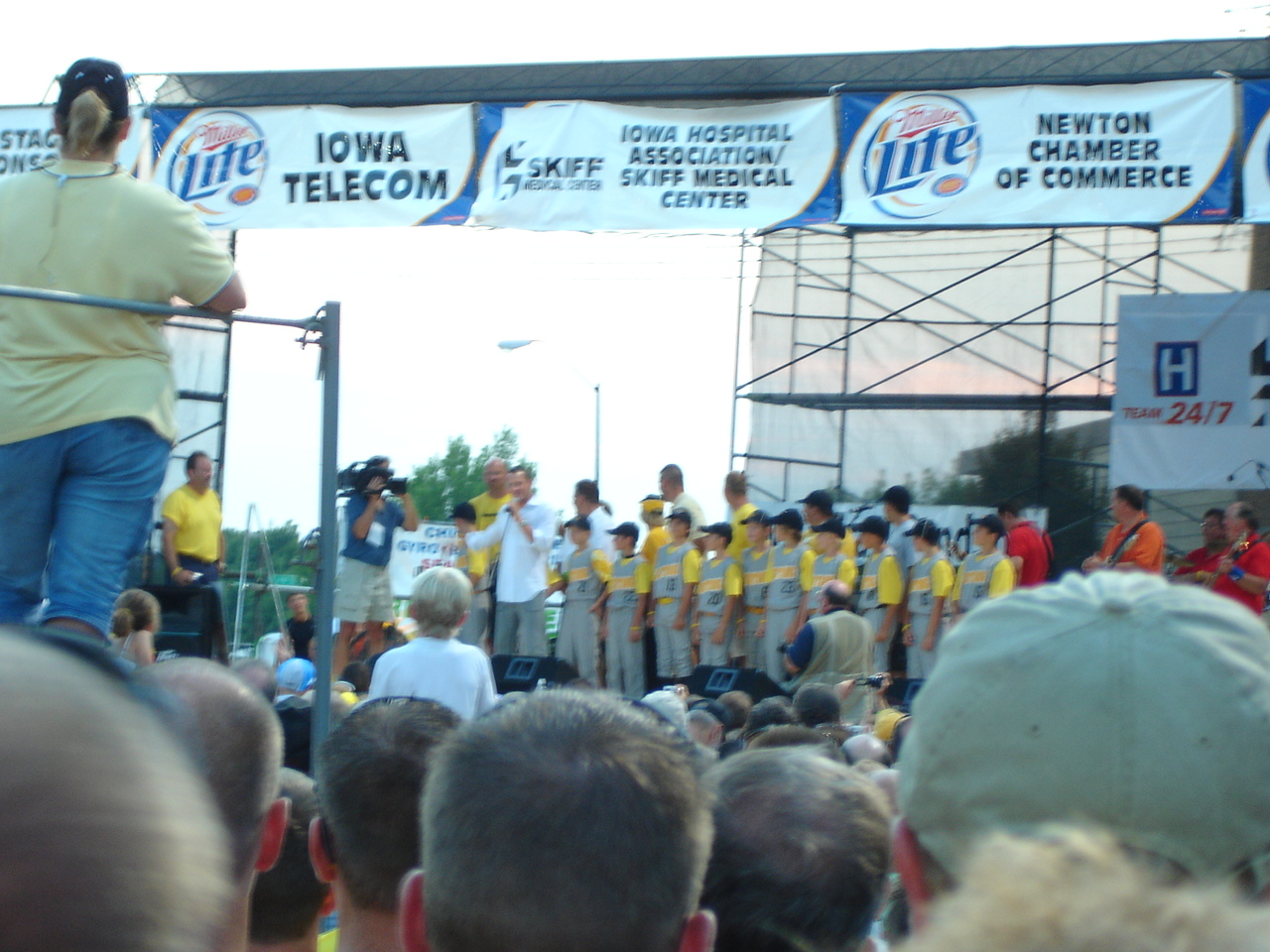
Lance Armstrong on stage in Newton. IA
That was the year a global celebrity invaded the cornfields. Lance Armstrong—having just retired from professional cycling—joined the ride. I was pedaling along a country road when a sudden, collective hum rippled through the pack. Within seconds, Armstrong and his sleek entourage flew past me on the road like a low-flying jet stream, a blur of carbon fiber and impossible cadence. That night, he took the stage in Newton to give a talk to the thousands of sun-baked cyclists crowded into the park.
The Rhythmic Hum
 When I look back at my photos today, it isn’t the celebrity encounter that brings back the real magic of 2006. It’s the photos of hundreds of riders filling the small country roads. The country roads boarded my miles of fields of corn and soy beans. A view that was completely incredible to look at: rural country road entirely shut down to vehicle traffic, replaced by a steady, infinite stream of hundreds of riders stretching out as far as the eye could see. I can still look at those pictures and hear it—the rhythmic, hypnotic hum of thousands of bicycle tires on pavement and the steady click-click-click of freehubs coasting down one hill just to gather the momentum to get up and over the next.
My bikes have since been sold and my long distance cycling days are over. I got into cycling as a way to loose weight and improve my health. I quickly achieved those goals. Cycling transformed my body and it also took me places. I biked all over the country but I also experienced an internal journey. I did things and experienced things I never would have imaged doing.
Twenty years ago, in the brutal July summer heat, I rode my bike across Iowa. My heart, lungs, and leg muscles did the work but I was sustained by the cold water at local firehouses, the home cooked meals I ate sitting on farm house lawns and in church halls, and the overwhelming kindness and hospitality of the hundreds of people in encountered in the small towns across rural Iowa.

J. Dawg at the end of RAGBRAI, on the banks of the Missouri River in Muscatine, IA – July 29, 2006


My, how time flies when you’re having fun.
My wife and I did RAGBRI in 2008. We also used Pork Bellies to transport on our and tent. I remember their motto “lower your expectations.”
They all did a great job caring for us.
We have enjoyed your postings for many years now, since retiring. The travel adventures have always been a treat! However, what we have grown to appreciate more and more is the community connections that you cultivate in your writing. This article is a beautiful example. Please keep up the great work. It is inspiring and needed. Thank you.
Thanks for your kind words and keen observation. When I look back, my travels and experiences might look like me doing interesting things solo but in reality it was also me engaging and joining communities. I became an RVer and connected with hundreds other fellow RVer’s. I became a snowbird and made many new friends like me moving south to escape the winters. I was a long distance cyclist, made new friends while cycling in group rides, and became a member of large tribe of spandex clothed cyclists. I became a blogger, met fellow bloggers and readers, and learned much from them. It has been the same with dancing, golf, pickleball, and church. While I was venturing out and engaging I became part of many communities. That has been, by far the biggest reward of my travels – completely unexpected and much better than any scenic vista.
J. Dawg
J, that was a great post about RAGBRAI. It is a fantastic experience for all that ride through my great state.
The small towns and the people that live in them are the backbone of our country and anybody that does the ride experiences something special. Along with aches and pains. 😎
Steven C Carfrae
Cedar Rapids, IA